Driveway Culvert Installation in Springfield, MO
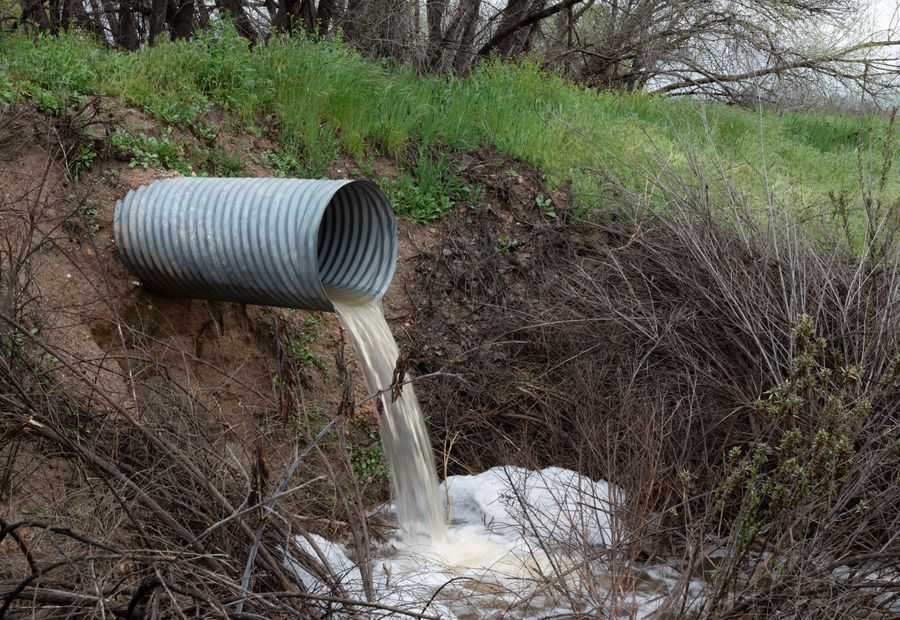
Springfield Culvert Company is an excavating contractor doing driveway culvert installation, culvert replacement and repair, farm and field entrances, approach grading, creek and lane crossings, outlet protection, and commercial entrance work. We serve acreages, farms, rural homes, and private roads across Springfield, Fair Grove, Willard, Rogersville, Ash Grove, and Greene County, Missouri.
We install Contech HEL-COR galvanized corrugated metal pipe and reinforced concrete pipe on entrances off county road right-of-way, because Greene County publishes a ban on plastic pipe in its right-of-way. The barrel goes on a shaped granular bed rather than a raw trench bottom. Structural backfill goes in on both sides together, in lifts, compacted evenly. Steel flared end sections close each opening and hold the fill back off the pipe. Angular rock on non-woven geotextile fabric takes the water at the outlet. Set that against a short pipe dropped in a trench and buried under the spoil that came out of it.
Sizing Comes From the Ditch
The question is not how wide your driveway is. The question is how much water reaches that ditch in a hard rain, and the answer sits uphill of you. Acres draining to the point, how steeply they fall, and what covers them. Ozark valleys are narrow and they fall fast, so a modest hillside behind a house delivers more water to a ditch than the ground looks like it should. A short driveway under a big catchment takes more pipe than a long driveway under a small one.
Too Big Is Also Wrong
An oversized pipe sits with its bottom below the ditch line. It silts in, holds standing water, and raises cattails. It also needs more cover to carry traffic, which lifts the whole driveway to reach it. Right sized, not biggest.
Grade, Bedding, and Cover
The pipe lies on the ditch flow line, running the direction the ditch already runs, with a slight steady fall from inlet to outlet. Flatter than the ditch and it silts. Crooked to the ditch and water hits the end at an angle, scours the shoulder, and starts working around the pipe. Cover is measured from the top of the barrel to the driving surface, and a residential entrance wants roughly a foot of it, compacted. Loaded trucks want more.
The Permit
Work in the right-of-way needs approval from your county or road district. In Greene County the Right-of-Way Inspector visits the site, checks placement, sets the culvert size, and issues a permit with installation instructions on it. The county inspects the finished work before sign-off, and the owner is responsible for having the culvert installed to those specifications. Our work follows the permit as written.
Booking
Summer and early fall give the driest trench. We measure and permit through the winter and dig once the ground opens. (417) 612-8230 reaches a person.
What size culvert do I need for a driveway?
The size comes from how much water the ditch carries at your entrance, and that comes from the acres draining to it and how steeply they fall. Fifteen and eighteen inch pipe covers most residential entrances around here. A bigger watershed above you, or a steep hillside dropping into your ditch, pushes it up from there. Counties set a minimum diameter and a minimum length, and on a Greene County road the Right-of-Way Inspector comes out and sets the size himself. We measure the ditch, then confirm the number with the road authority before we quote.
How much does it cost to install a driveway culvert?
A new residential entrance usually lands between eighteen hundred and forty-five hundred dollars installed. What moves it: the diameter, how long the pipe has to be for the width of your entrance, whether it is steel or concrete, flared end sections versus a poured headwall, rock at the outlet, how much approach gets rebuilt, and whether an old pipe has to come out and go away. Rock in the trench moves it too, and around here that is common. The permit fee is separate from our price and it is small.
Who owns the ditch in front of my house?
The ditch along a public road normally sits inside the road right-of-way, and the road authority controls that ground even where your property line runs past it. That is the reason a permit exists at all. Who maintains it depends on the road: a county highway department, an independent road district, a city, or the state. Where your line actually falls is a question for your deed and the county map, not for us.
Do I need a permit to install a driveway culvert?
Yes, on any public road. The authority that maintains that road issues it, so on a county road it is the county and elsewhere in Missouri it can be a special road district. It is normally a short form and a small fee. The road department commonly sets the pipe diameter and the minimum length as a condition of approval, and in Greene County an inspector visits the site to do exactly that. We pull it with you or walk you through it, and nobody can promise you an approval before that visit.